



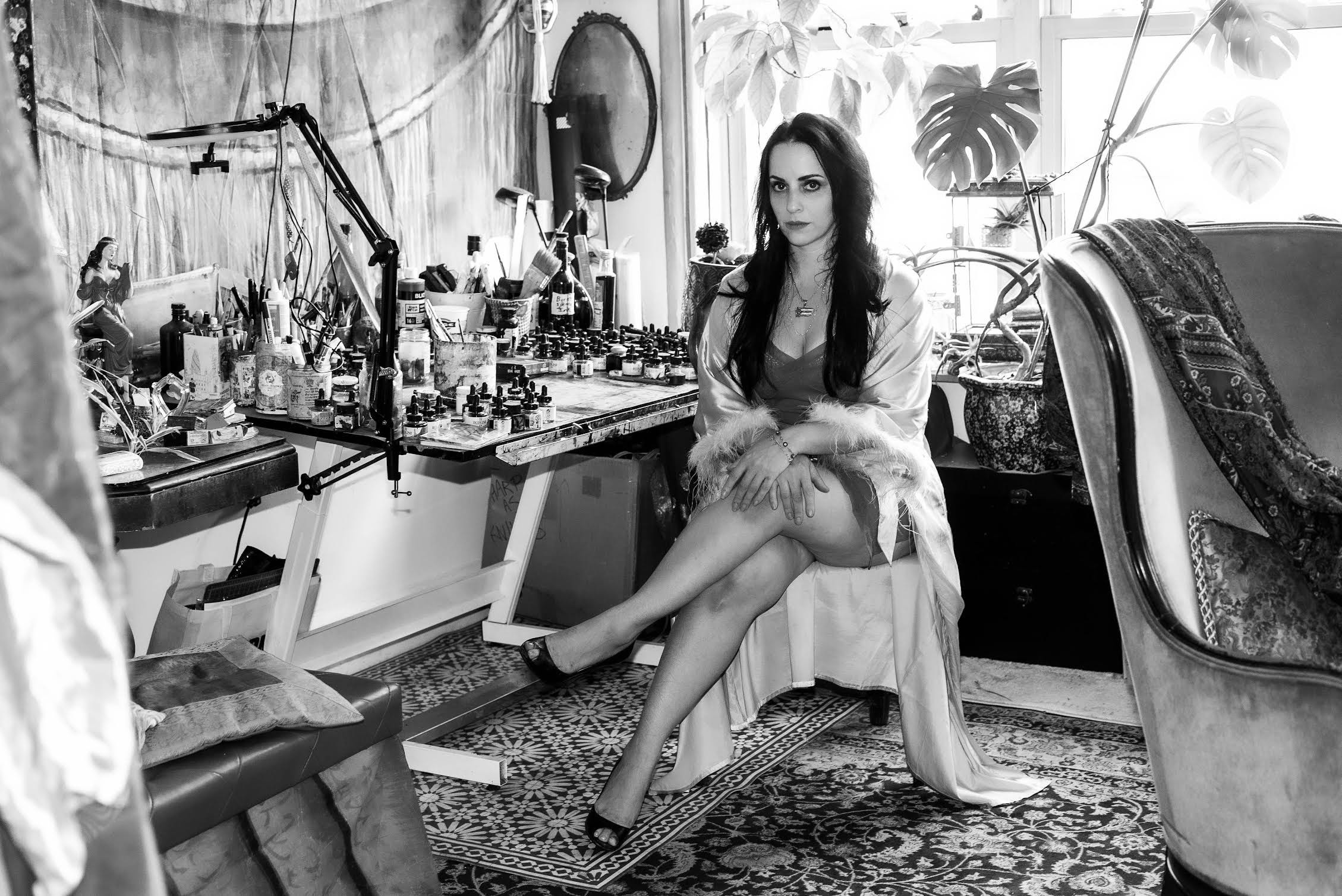
Molly Crabapple and I met while doing graffiti with a mutual friend: three women in her art-filled Manhattan loft, stirring a gluey pot of wheatpaste like a witches’ brew. Later, it would be used to erect posters of her art all around the city: portraits of activists, of politicians, of burlesque dancers, fire performers and everything in between. Molly is an artist whose work is explicitly tied to revolution; she has been described as a “punk Joan Didion,” “a young Patti Smith with paint on her hands,” “art’s Alexandria Ocasio-Cortez.”
Molly’s work has brought her to the front lines of war zones, but also to autonomous zones: temporary, self-governing communities that embody a utopian vision of social change. There, protest becomes something closer to a party: a space for free expression, community building, and saying “fuck you” to the powers that be. She’s known as the foremost artist to document Occupy Wall Street—but before that, she got her start in the burlesque world serving as house artist for iconic nightclub The Box.
She has graced these stages herself, swallowing fire and dancing on broken glass during her brief stint as a burlesque performer. But the most recent stage I saw her on was at New York’s Public Library, at a sold-out event celebrating her recent bestseller, Here Where We Live Is Our Country: The Story of the Jewish Bund. Seven years in the making, the book unearths the untold stories of an early-twentieth-century socialist movement that opposed ethnic nationalism—documenting a history that’s been all but forgotten, yet contains essential lessons about what it means to fight for radical change.
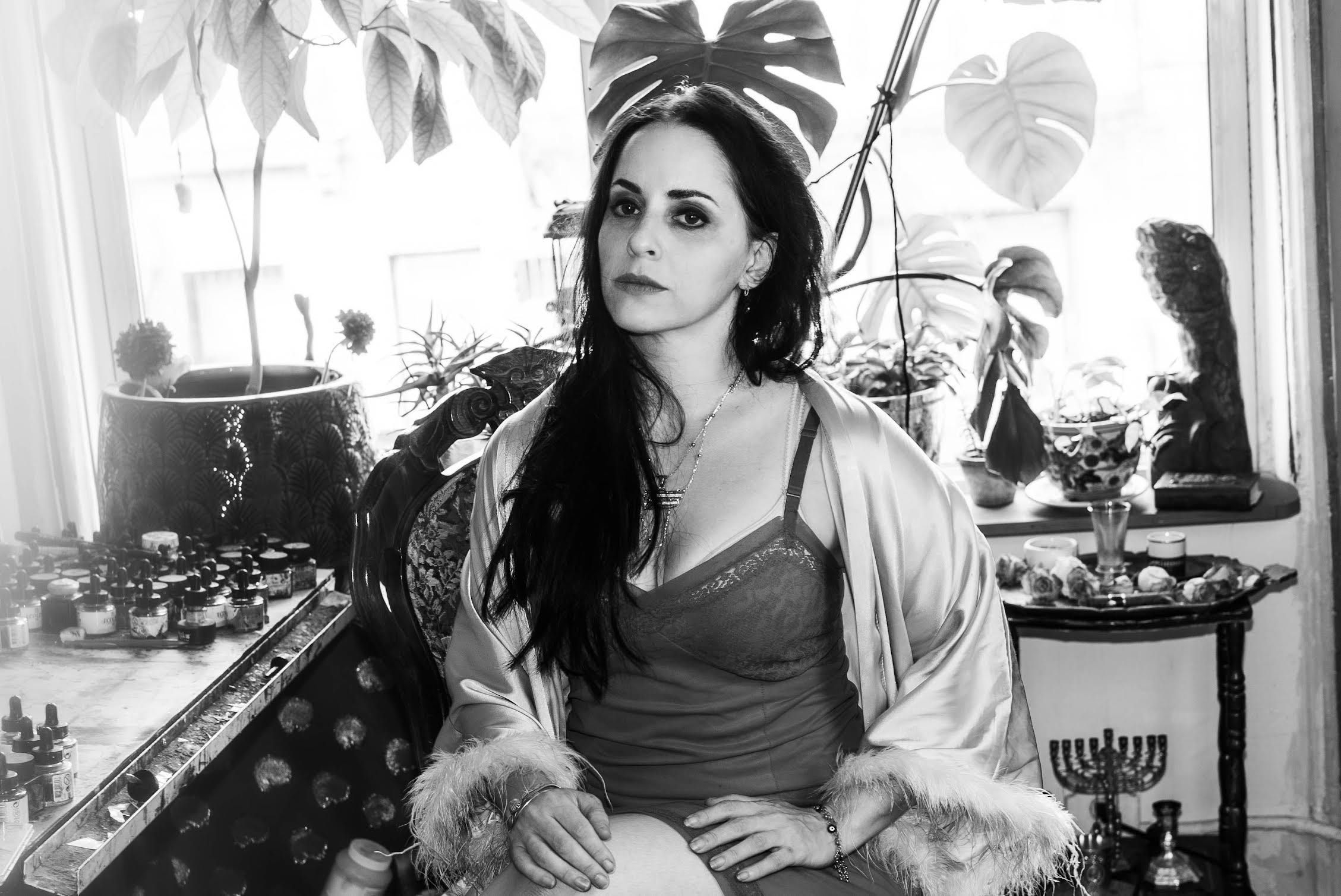
There are many things I love about Molly’s approach to art. Perhaps the most important is that, even as she turns her pen toward the most urgent political movements of our times, she never loses track of the human desires—sexuality, freedom, self-expression—that shape them. In her work, seriousness doesn’t undermine sensuality; instead, the life-affirming power of pleasure plays a role in revolution, reminding us what a better world might look like, and what it takes to get there.
This conversation is co-published by Pleasure-Seeking and Elephant Magazine as Camille Sojit Pejcha’s column, Figure Study, and is based on a public talk given at the museum Poster House. You can order Molly’s latest book, Here Where We Live Is Our Country, here.
Camille Sojit Pejcha: You have been called the millennial generation’s first radical artist, and the Alexandria Ocasio-Cortez of the art world—but actually, you got your start in burlesque. How did that experience impact the iconography in your work?
Molly Crabapple: I grew up obsessed with Toulouse-Lautrec. I was always looking for my own Moulin Rouge, and when I was 19, I found that in the underground burlesque scene of New York City. These performers were as tough and sharp as diamonds, and they spent hours schlepping their costumes, attaching Swarovski crystals to their corsets, changing in alleyways, and waiting around for five hours through the very worst rock bands the city has ever produced—all so that they could incarnate the divine for three minutes onstage, where I watched them turn into gods and goddesses every night.
Camille: Something I love about your work is that you’ve allowed both of those themes to coexist—and even as you have embraced being on the front lines of war zones, you’ve refused to abandon sensuality. What do you think people get wrong about the relationship between the two?
Molly: People like to divide the world into two different realms: the sexy and the serious. There are the hot slutty girls in corsets doing some sort of shimmy, and then there are the serious men who talk about politics and shape the future. And that division is so stupid. Because everything I’ve ever done since—drawing at a protest, at an occupation, at a checkpoint—comes down to those skills that I learned in the nightclub.
Camille: Before you were known for your political work, you were the house artist at The Box. For those who don’t know it, can you describe the scene?
Molly: I started working as the house artist for The Box in New York before the financial crisis of 2008, before the stock market crashed. It looked like an old school bordello, and the worst people in the world would go there to spend $20,000 on champagne in one night. You had acts on stage that were the crème de la crème of what underground performance could be. You had drag queens and acrobats, you had people hanging by their toes over a rotating saw. You had a drag queen named Rose Wood who mimed the murder of an audience member on stage, then put on his clothing and left.
You had the rich—who wanted to be around the sexy and interesting people—and you had the sexy and interesting people, who wanted the money of the rich. They wanted each other so much, but they fucking hated each other so much. That’s what I mean when I say it was class war.
Camille: At one point in your memoir Drawing Blood, you talk about painting The Box while a protest kicked off around you. Can you share a little about that experience and what questions it introduced for you as an artist?
Molly: It was a real moment of change for me. I grew up in a good Marxist home; my dad taught me about surplus value when I was four, so it was not like political action or protests were foreign to me. But for a long time, I felt like they weren’t things that I could engage in with my art—and the reason was that I, too, had internalized that dichotomy where there are the serious things over here and the sexy things over here, and I was drawing the sexy things.
And when I was in London, painting The Box, there were these huge student protests—they’d taken over part of the London School of Economics, and they were being kettled out in the cold or beaten bloody in the streets. And I was just like, what the fuck is wrong with me? History is happening outside, and I’m painting pigs in the nightclub.
Camille: When we first met, I’d come from reporting on Occupy City Hall. We bonded over our shared interest in temporary autonomous zones—an ephemeral space where people create self-governing communities embodying freedom and direct action, often in the face of oppression. Can you speak a little to the relationship between pleasure and activism, the almost party-like nature of these spaces?
Molly: I came to Occupy Wall Street on the first day, and by the second day, it was no longer just a protest. They were starting to build what I can only describe as a mini-city inside a square, devoted to prefigurative politics—to embodying the world you wanted. Soon, an entire infrastructure had sprung up, from a library to a kitchen with gourmet food to a table where punk kids were giving out cigarettes, to a cursed drum circle that everyone hated, to a free store, to a clinic… everything.
Camille: You went on to become the foremost artist associated with the movement. What about it was so compelling to you, and what did you want to translate through your work?
Molly: Occupy was radical because in a city where every inch of it is about buying and selling, this was a place where you could be; you could exist, and you could contribute. I became very angry, because the way the media was portraying the movement was so different from what I saw. What I saw was every type of person was there to protest against the corrupt oligarchy that was wrecking all of our futures. And what the media portrayed was a bunch of losers in ill-fitting tie-dyed leggings saying incoherent shit. I was like, this is bullshit. And so I decided to draw it.
Camille: You also turned your apartment into something of a community hub.
Molly: Yes. I lived near Occupy, so I invited journalists and activists from the Square to come to drink my whiskey, plug in their laptops, and get warm. I got to know journalists that way, and I got to envy them because what the market wants from artists is that we take our most successful work and plagiarize it in increasingly large formats until we die. Meanwhile, journalists were seeing history as it happened. I was so jealous! And so I decided to try to use my sketchbook like a photojournalist uses a camera. And so I would go down to the square, and I would draw about how fun these temporary autonomous zones are.
In this city where every bit of our streets are so privatized that even the subway turnstile has an ad on it, this was a public place—that was about creating something together, with all the friction and the mess that that implies. We were saying, ‘This is our city too, and we can make this ours.’ And that attitude makes for the very best parties.
Camille: Tell me about the series, Shell Game, that grew out of your work on Occupy.
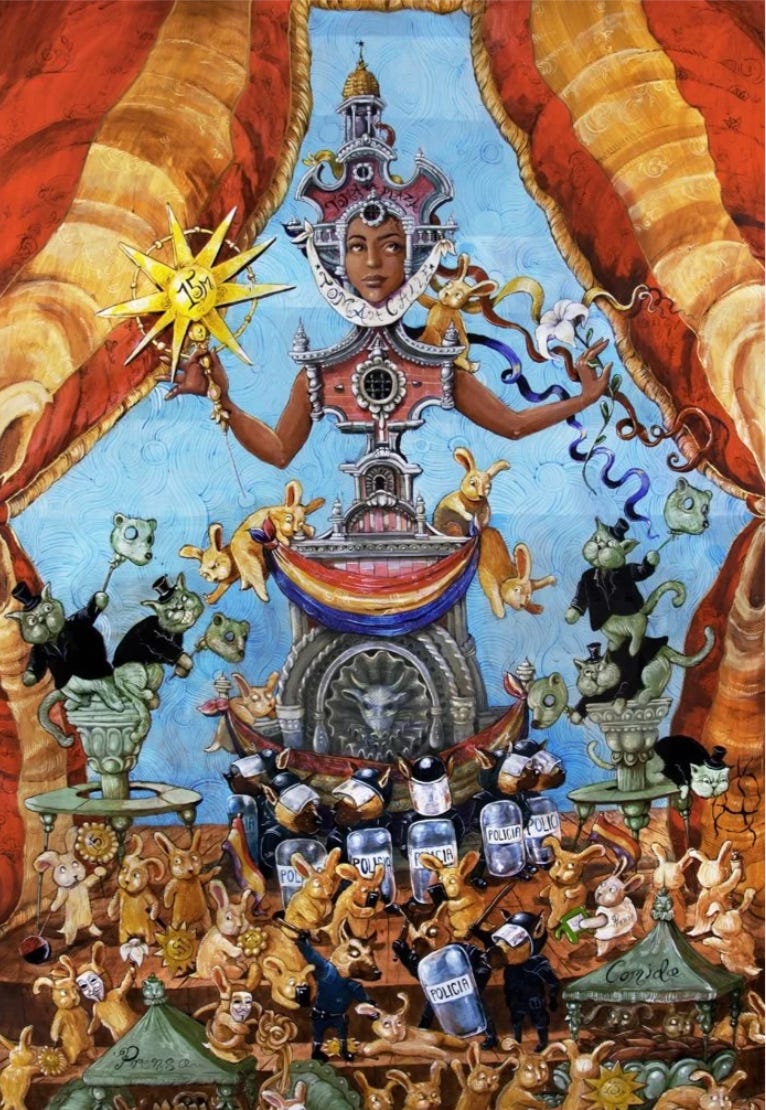
Molly: Shell Game was a series of paintings that was supposed to represent the insurrections and crises of 2010 to 2012—the medical debt crisis, the housing bubble. But also the political possibilities. And I drew these figures using the same iconography that I had learned in nightclubs. I used allegorical animals to represent the different groups, and put them in these surreal, fantastical costumes. It was this fusion of the art that I had done before and the art that I would move towards. The thing that you were saying about refusing to abandon either part of it—well, Shell Game really represented that to me because it had the visual iconography of performance, but the content was radical politics.


Camille: Talking about the merging of these worlds—the landscape of The Box, and of temporary autonomous zones—makes me think about some of the sex parties I report on, from the week-long swinger’s cruise I covered for Playboy to parties in New York that grew out of the Burning Man community. A lot of these spaces aren’t as much about sex as creating somewhere people can feel free, where the rules and norms of society don’t apply. But a lot of these parties are really expensive, and the vibes are off—the shadow of capitalism influences the social dynamics at play, and the kind of people who attend are also those who aren’t living the kind of radical bohemian life they seek.
I’m curious about what you see as the relationship between personal liberation and carving out these spaces, and the broader class and power structures that still govern them. Why can’t a sex party be an autonomous zone?
Molly: The reason that those sex parties don’t feel the same as the temporary autonomous zones or even normal parties is that they’re trying to eliminate risk. If you think about what a consumer experience is—it’s about having no risk. If I order socks, I want them to appear for me. If they don’t, that’s bad. And so what these bankers are doing is trying to get the experience of going to some depraved bohemian party, but they don’t wanna risk the fact that no one might be attracted to them. They don’t wanna go in as an equal, they wanna go in as a consumer—and that’s why they’re paying like $10,000 or whatever. They’re paying for the facsimile of risk and danger and pleasure, without it potentially not being exactly what they want. And that’s why it seems so fake.
Camille: We’re in an increasingly capitalistic, tech-mediated world. Can you speak a little about how embracing the analog is inherently rebellious, and how our own relationship with pleasure can push back against the status quo?
Molly: I’m an AI hater, and one of the reasons that I particularly hate it is philosophical—this idea that the world should be frictionless. But if you think about what friction means at the end of the day, it’s other people. You can use a gig app to get food, or you could go to a store, where you might joke with the guy who works there. You might see a cute girl you can flirt with, or run into your ex, and it puts you in a tailspin. You could pet the bodega cat and have all these encounters on the street on the way to and from the store.
They want a frictionless world where everything is pure consumption—where the only thing you feel is your finger sliding down the glass of a phone. You live in this bubble of pure reinforcement, a sort of Wally-World where everyone is like drinking their Big Gulp and not troubling themselves to have to hurt their little head thinking. But the basis of pleasure is friction—so reject that shit! Reject it, and commit to other people. Commit to this fucking precious world that we live in, because no app being hawked by some nerd-worm like Sam Altman can ever be better than this amazing world that we’ve all built with each other.

Thank you for an excellent interview. I must add that I agree with Molly about AI -- completely!
But must there always be a cursed drum circle!?!?!